
When it comes to communication at work, it seems all we hear lately is people trying to kill off email. And yet, our inboxes are still full of “FWD: Re: Re: RE: Re: Von: Re:” subject lines. Even Slack, the premier would-be assassin of the electronic mailman, recently decided to adopt the “if you can’t beat them, join them” approach and embrace email.
Yet dreams of killing off the pesky service persist. Jamie Pride, co-founder and managing director of Australia-based startup Reffind, tells me it’s one of his personal long-term goals. But he’ll settle for reducing the load in an employee’s inbox by about 20 or 30 emails for now. Given the number of emails I get every day, hey, I’ll take it.
Reffind is a mobile-only app built around three main pillars. It’s a job referral app, an employee training tool, and a way to keep employees engaged and informed through things like employer surveys. “We founded Reffind as a platform to help companies communicate with mobile workers in a really fun, fast, and engaging way,” Jamie says. Reffind’s reasoning is that employees today usually have access to, and are even able to do business through, a smartphone. Some of them, working in places such as retail stores, don’t have the luxury of a work computer.

Reffind co-founder and managing director Jamie Pride
The company’s founders have a rich background in corporate and enterprise work. Jamie has over 20 years of experience in senior positions at technology companies like Salesforce and Cisco. He also counts a partner stint at Deloitte and a successful exit as co-founder of customer engagement startup Velteo (which was acquired by New York-based system integrator Bluewolf in 2012) as part of his resume.
His co-founder at Reffind, Ben McGrath, is a user experience specialist who has worked with such names as VMware, Symantec, Telstra, Vodafone, GSK, Pfizer, and Singtel Optus. He also has a successful exit under his belt, having co-founded UI design and app development startup Freshweb. He sold that company to Australian marketing firm Now Communications in 2012.
“One area we’ve found lacking is [employers’] communication with employees,” Jamie says. Reffind feels employee experience is just as important for a business as customer experience, and this is something that gets overlooked these days. Sure, many companies throw massive amounts of money at innovative workplaces, with funky colors on the wall and various sizes of bean bags on the floor, but they still use traditional communication tools to keep in touch with their employees, he explains.
The power of three
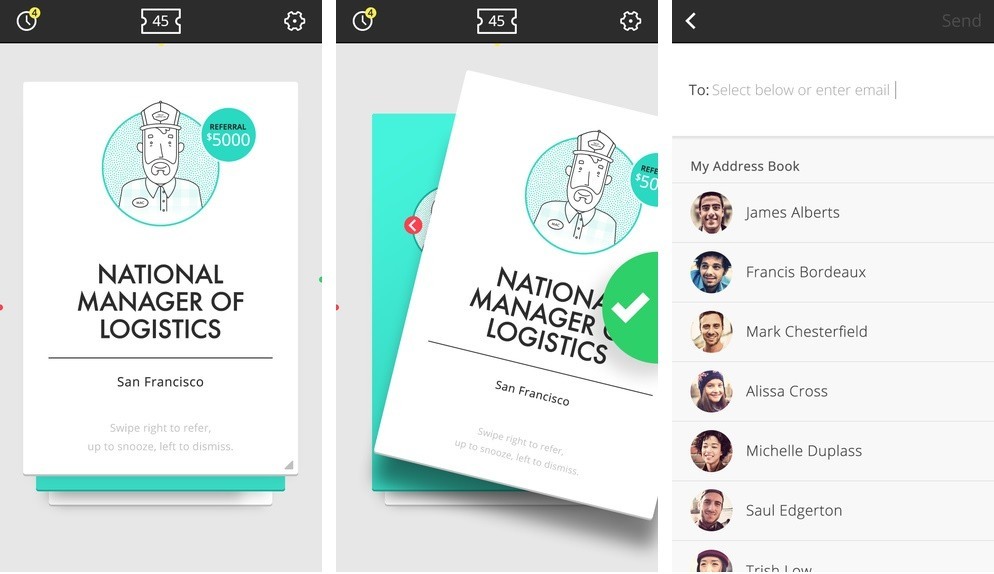
Reffind launched first with its job referral product, Employ. It’s a card-based interface that resembles Tinder in presentation and use – you use swipes to approve, reject, or snooze a card, while tapping on it reveals more details about the prospective employee. This way, an employer can go through a number of cards and get the information she needs quickly and easily. Referrers get incentives such as referral bonuses and prize draws.
The Engage product launched just this week, and it’s a way for employers to connect with their employees and get a feel for any problems in their work or workplace. The app allows the employer to send out quick surveys to the staff, but sets some limitations. “We don’t want it to end up as noisy as email,” Jamie says.
Currently, it allows the employer to send one survey a week, and one more per month if needed. This way, the tool can provide useful insights without getting too spammy, Reffind hopes. Engage has already drawn interest from two large companies in Australia, energy management specialist Schneider Electric and IT services provider Interactive.
The Educate product is still in development at the moment. The startup wants it to take the form of video tutorials for employee training. It’s now considering factors such as video length and type of content to make sure it’s useful, enjoyable, and not an extra chore for its intended audience. “To do training now, you have to take your workforce out of action for a while and deliver content in a dry and boring way,” Jamie says. “This can be disrupted by quality, short-form content.”
As an example of his thinking there, Jamie brings up in-flight safety videos, a type of content that’s informative but no one ever watches. Air New Zealand was successful with its own version, however, by using imagery from the Lord of the Rings films (which were made entirely in the New Zealand) to engage, entertain, and educate viewers.
Targeting Asia
Reffind is already working with several corporate customers in Australia and beyond, including Coca-Cola, Fuji Xerox, financial services company AMP, supermarket chain Coles, Dutch global electronic markets trader Optiver, and more. The startup also recently announced a partnership with multinational HR firm Randstad to help it expand into Asia.
“Randstad [was] already using Reffind internally to assist with its own referral program, so it was straightforward to extend this out to its technology contractor base,” Jamie says. The HR company will use the platform to attract candidates in Australia, New Zealand, Singapore, Malaysia, and Hong Kong. “We see real opportunity to expand quickly in Asia,” Jamie points out. The startup is also looking to begin expanding to the US, expecting to launch there in late September or early October.

Public face
Reffind had an uncommon development as a startup in that it went for an IPO almost a year after it was founded. Though there are exceptions like Ben Horowitz’s Loudcloud, that doesn’t usually happen. The company listed on the ASX in July, raising A$8 million (US$5.73 million) from issuing 40 million shares at 20c apiece.
Jamie says the decision was made to go public in order to capitalize on the startup’s early momentum. “We’re a company that can drive revenue more quickly,” Jamie says. “It’s been very easy for us to raise capital, [and] it just means we can realize our strategy faster.” In addition, he feels that being a listed company makes it easier for customers to trust it. “They have at least a sense of confidence that [we] are going to be around in 24 months,” he says.
Reffind’s advantage over its competition seems to lie in its combined approach, unifying job referrals, corporate communication, and corporate training in one neat package. While other online platforms such as Zao for job referrals, and AppRise for corporate communication, zero in on their respective sectors, Reffind provides businesses with a platform that takes care of multiple functions, is easy to set up and use, and looks quite spiffy in the process.
“It’s a piece of technology that’s typically marketed to HR teams and directors, and they’re an important part of our business, but we built this so that employees will love it,” Jamie says. “Our biggest competitor is email and outdated forms of communication.”


0 Response to "This startup built a product so successful, it went public before it was even finished"
Posting Komentar